
ARM9微控制器的CAN ,LIN和USB ARM9 microcontroller with CAN, LIN, and USB
Overview
The LPC2926/2927/2929 combine an ARM968E-S CPU core with two integrated TCM blocks operating at frequencies of up to 125 MHz, Full-speed USB 2.0 OTG and device controller, CAN and LIN, 56 kB SRAM, up to 768 kB flash memory, external memory interface, three 10-bit ADCs, and multiple serial and parallel interfaces in a single chip targeted at consumer, industrial and communication markets. To optimize system power consumption, the LPC2926/2927/2929 has a very flexible Clock Generation Unit CGU that provides dynamic clock gating and scaling.
MoreLess
## Features
* ARM968E-S processor running at frequencies of up to 125 MHz maximum.
* Multi-layer AHB system bus at 125 MHz with four separate layers.
* On-chip memory:
* Two Tightly Coupled Memories TCM, 32 kB Instruction TCM ITCM, 32 kB Data TCM DTCM.
* Two separate internal Static RAM SRAM instances; 32 kB SRAM and 16 kB SRAM.
* 8 kB ETB SRAM also available for code execution and data.
* Up to 768 kB high-speed flash-program memory.
* 16 kB true EEPROM, byte-erasable and programmable.
* Dual-master, eight-channel GPDMA controller on the AHB multi-layer matrix which can be used with the Serial Peripheral Interface SPI interfaces and the UARTs, as well as for memory-to-memory transfers including the TCM memories.
* External Static Memory Controller SMC with eight memory banks; up to 32-bit data bus; up to 24-bit address bus.
* Serial interfaces:
* USB 2.0 full-speed device/OTG controller with dedicated DMA controller and on-chip device PHY.
* Two-channel CAN controller supporting FullCAN and extensive message filtering.
* Two LIN master controllers with full hardware support for LIN communication. The LIN interface can be configured as UART to provide two additional UART interfaces.
* Two 550 UARTs with 16-byte Tx and Rx FIFO depths, DMA support, and RS485/EIA-485 9-bit support.
* Three full-duplex Q-SPIs with four slave-select lines; 16 bits wide; 8 locations deep; Tx FIFO and Rx FIFO.
* Two I²C-bus interfaces.
* Other peripherals:
* One 10-bit ADC with 5.0 V measurement range and eight input channels with conversion times as low as 2.44 μs per channel.
* Two 10-bit ADCs, 8-channels each, with 3.3 V measurement range provide an additional 16 analog inputs with conversion times as low as 2.44 μs per channel. Each channel provides a compare function to minimize interrupts.
* Multiple trigger-start option for all ADCs: timer, PWM, other ADC, and external signal input.
* Four 32-bit timers each containing four capture-and-compare registers linked to I/Os.
* Four six-channel PWMs Pulse Width Modulators with capture and trap functionality.
* Two dedicated 32-bit timers to schedule and synchronize PWM and ADC.
* Quadrature encoder interface that can monitor one external quadrature encoder.
* 32-bit watchdog with timer change protection, running on safe clock.
* Up to 104 general-purpose I/O pins with programmable pull-up, pull-down, or bus keeper.
* Vectored Interrupt Controller VIC with 16 priority levels.
* Up to 21 level-sensitive external interrupt pins, including USB, CAN and LIN wake-up features.
* Configurable clock-out pin for driving external system clocks.
* Processor wake-up from power-down via external interrupt pins; CAN or LIN activity.
* Flexible Reset Generator Unit RGU able to control resets of individual modules.
* Flexible Clock-Generation Unit CGU0 able to control clock frequency of individual modules:
* On-chip very low-power ring oscillator; fixed frequency of 0.4 MHz; always on to provide a Safe_Clock source for system monitoring.
* On-chip crystal oscillator with a recommended operating range from 10 MHz to 25 MHz. PLL input range 10 MHz to 25 MHz.
* On-chip PLL allows CPU operation up to a maximum CPU rate of 125 MHz.
* Generation of up to 11 base clocks.
* Seven fractional dividers.
* Second CGU CGU1 with its own PLL generates USB clocks and a configurable clock output.
* Highly configurable system Power Management Unit PMU:
* clock control of individual modules.
* allows minimization of system operating power consumption in any configuration.
* Standard ARM test and debug interface with real-time in-circuit emulator.
* Boundary-scan test supported.
* ETM/ETB debug functions with 8 kB of dedicated SRAM also accessible for application code and data storage.
* Dual power supply:
* CPU operating voltage: 1.8 V ± 5 %.
* I/O operating voltage: 2.7 V to 3.6 V; inputs tolerant up to 5.5 V.
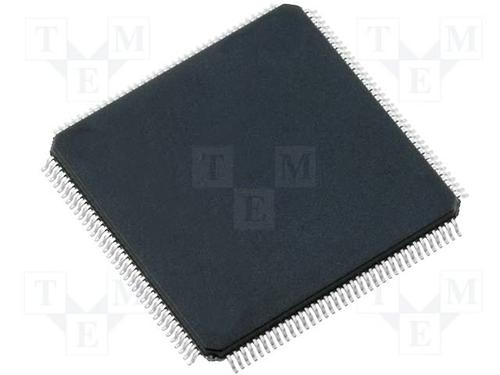
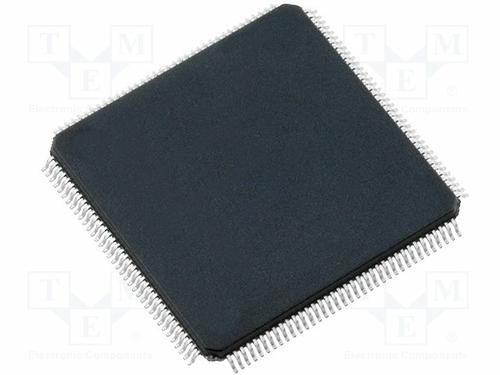
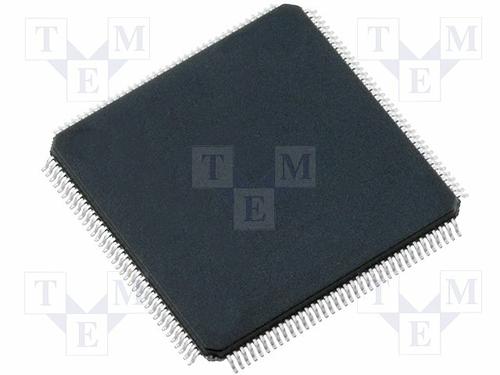
* 144-pin LQFP package.
* –40 ℃ to +85 ℃ ambient operating temperature range.
## Features